How many English words do you need to be fluent?
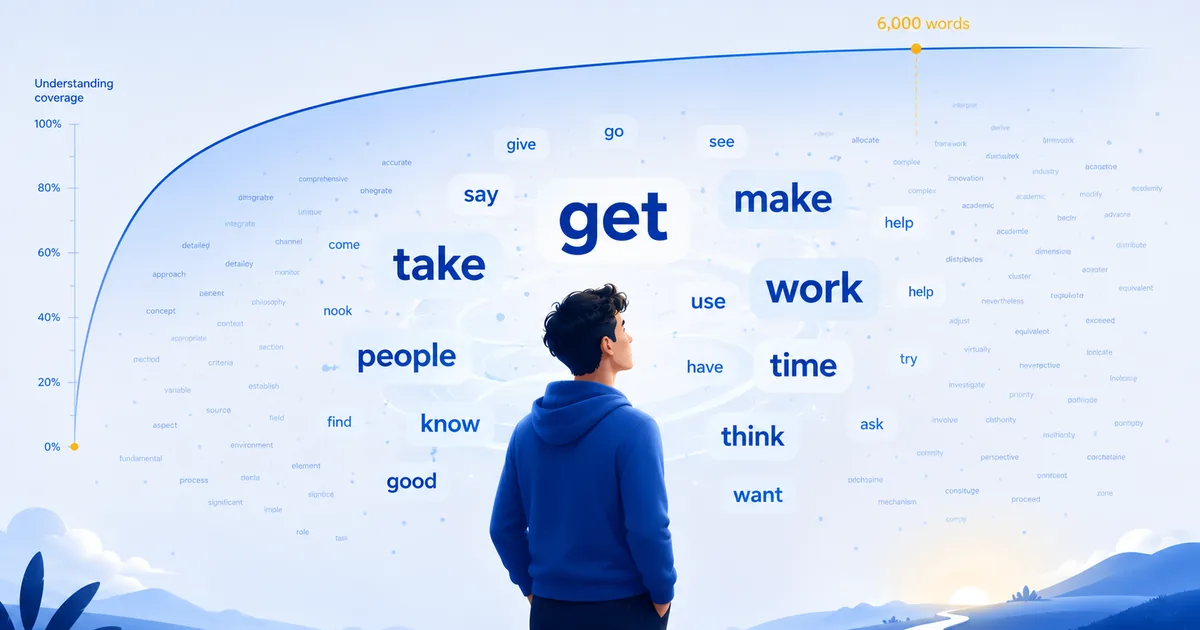
Around 6,000 words, English stops feeling foreign. You follow a film to the end, you read an article, you hold a conversation without stalling every second sentence. The more interesting number is smaller: the first 1,000 words already cover 85% of everyday speech.
Vocabulary size, far more than grammar, decides what you understand. Grammar tells you how words fit together. Without the words, there is nothing to fit.
How many words cover how much English?
Linguists measure vocabulary as text coverage: the share of words you recognise in a conversation, a text or a film. The work of Paul Nation, a leading researcher in the field, gives stable figures.
- 1,000 word families cover about 85% of spoken English.
- 3,000 families take you to 95%. Most conversations hold together, with gaps.
- 6,000 to 7,000 families reach 98% of speech, the threshold researchers link to comfortable listening, where an unknown word can be guessed from context.
- 8,000 to 9,000 families are needed for that same comfort when reading novels and newspapers.
The step from 95% to 98% weighs more than it looks. At 95% you hit an unknown word every two or three sentences, and it is often the word carrying the meaning. At 98% the gaps become rare enough for context to fill them. This explains a very common complaint: following your coursebook and understanding nothing of a series without subtitles. Coursebooks live inside the first 2,000 words. Real English does not stop there.
What counts as one word?
The unit changes the answer. Run, runs, running, ran, runner is one word family, five tokens. Nation counts families, which is why his figures look low next to the numbers you see quoted elsewhere. Someone claiming a 10,000-word English vocabulary is counting tokens, and their family count sits nearer 4,000.
This matters when you pick a list. A frequency list built on tokens will hand you go, goes, went, gone as four separate items and burn four review slots on one verb. English Progress counts families, so an irregular verb costs you one entry and the forms come with it.
Order matters more than count
English word frequency draws a very steep curve. The, be, to, of, and appear everywhere, while the vast majority of the dictionary's 170,000 entries almost never surface. Three practical consequences.
- Learning the 1,000 most frequent words first buys more comprehension than learning 3,000 at random.
- Every hour spent on rare words before the frequent ones are solid is an hour invested on the wrong side of the curve.
- Themed lists only pay off when they are also filtered by frequency: the useful words of each theme first.
That is the principle English Progress is built on. Its 6,000 words are ordered by real-world frequency and grouped by theme, so every session works on words you will meet again.
The milestones, in practice
- 500 words: survival. Ordering, asking directions, getting through.
- 1,000 words: simple exchanges on familiar topics.
- 3,000 words: conversational comfort, series with subtitles.
- 6,000 words: films without subtitles, newspapers, a working day in English.
- Above 10,000: nuance, humour, specialised fields.
How long does 6,000 English words take?
Less time than you would think, on two conditions: learn in short daily sessions, and review at the right moment so the words stay.
At 10 words a day, five minutes of learning plus a few reviews, you pass 1,000 words in under four months and 3,000 within a year. Forgetting sets the ceiling here. Without a review system, most of those words evaporate in weeks. That is where spaced repetition comes in: it places each review just before the word fades, so the total climbs instead of leaking.
The useful question is not "how many words?" but "how do I make them stay?". Aim for the 6,000 most frequent, in order, with reviews scheduled for you, and the count takes care of itself.
How do you find out where you are?
Take something you want to read, an article or the first page of a novel, and count the words you cannot guess in the first hundred. Five unknown words means you are at 95% coverage. One or two means 98%, and the text will feel easy. Ten or more means the text is above your level and reading it will cost more than it teaches.
Run the same count on a podcast transcript. Most learners score three or four points lower on speech than on writing, because spoken English leans on the phrasal verbs and short Germanic words that textbooks skip. If your reading count is comfortable and your listening count is not, the gap is vocabulary, not your ear.
One caution about the numbers on this page: they describe recognition. Understanding 6,000 words does not mean you can produce them. Most learners recognise two to three times more than they can retrieve, which is why review that asks you to recall a word, rather than tick that you knew it, builds speaking and not only comprehension.
Sources
Learn the 6,000 most frequent English words, 5 minutes a day.